From HAL to Jarvis, part 1 of 7. A history of artificial intelligence, told as a story, for people who will use it. It began as a talk.
Two assistants
Here are two assistants from science fiction.
The first is a red eye in a white corridor. HAL 9000, 1968. Arthur C. Clarke wrote him, Stanley Kubrick filmed him, and he has been the picture of a machine gone wrong for almost sixty years. Which is unfair to HAL, as you will see. HAL never did anything he was not told to do.
The second is a voice in a workshop in Malibu. Jarvis, who was a butler in the comics for forty years before he became a voice in 2008. Tony Stark mutters, and the suit is ready. Tony never explains himself. He does not have to.
Both are fiction. One of them is nearly real.
HAL does what he is told. Jarvis knows what is meant. Everything between those two sentences is the history of this field, and it took seventy years.
We are such stuff as dreams are made on.
William Shakespeare, The Tempest, IV.i
A history of artificial intelligence should begin with engineers. This one begins with dreamers, because in every age I know of, the dream came first, often centuries first, and the dream was the specification. The engineers arrived later and paid the bill.
Leonardo, the late 1480s
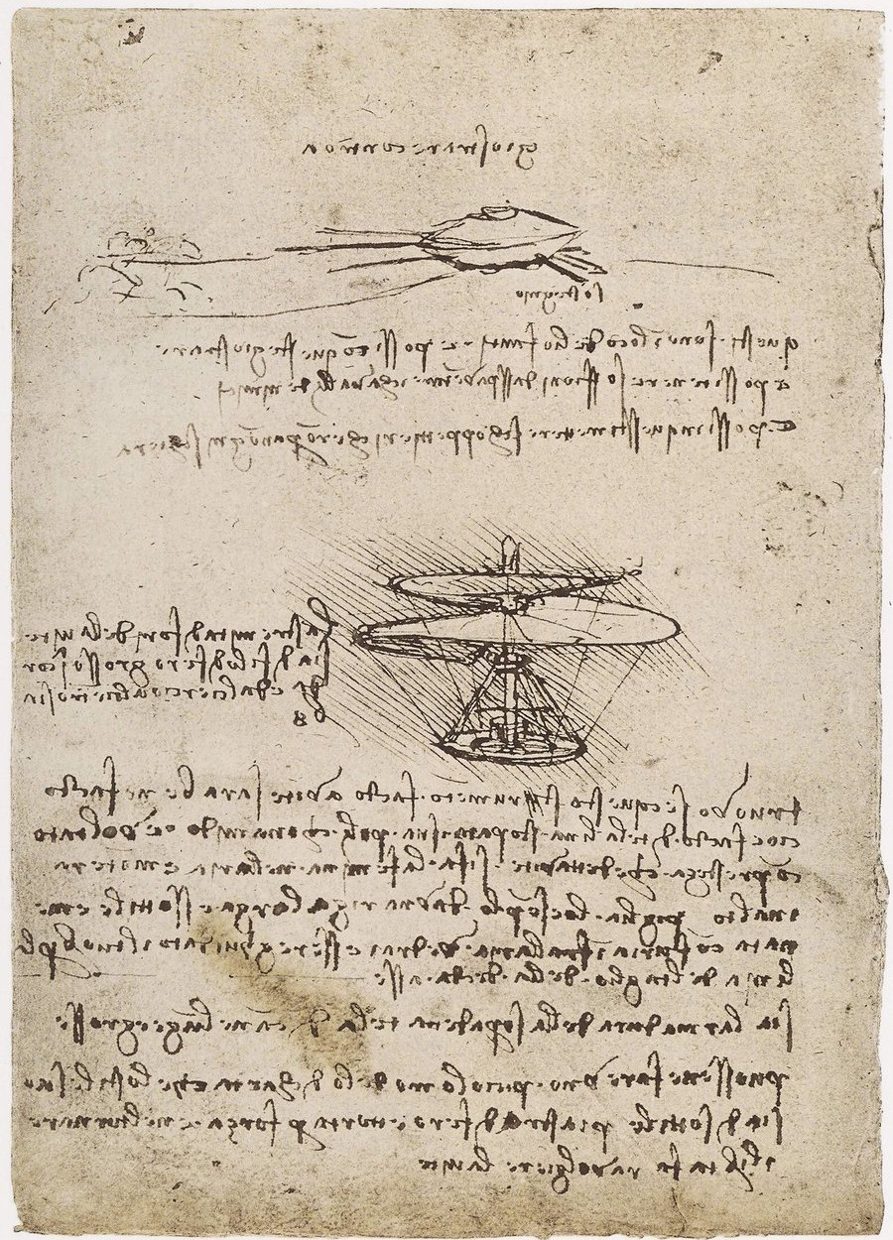
In a Milan notebook, Leonardo da Vinci draws a helix of linen and wire, wound around a mast, and writes beside it that if the instrument is well made and turned swiftly, the screw will make its spiral in the air and rise high.
It was never built. It could not have flown. No engine on Earth could turn his screw fast enough, and no engine would exist for four hundred years.
In September 1939, in Connecticut, Igor Sikorsky lifts the VS-300 off the ground. America’s first practical helicopter. Four and a half centuries after the sketch.
Leonardo got the machine right. He drew the aircraft. He could not draw the engine.
Verne, 1865
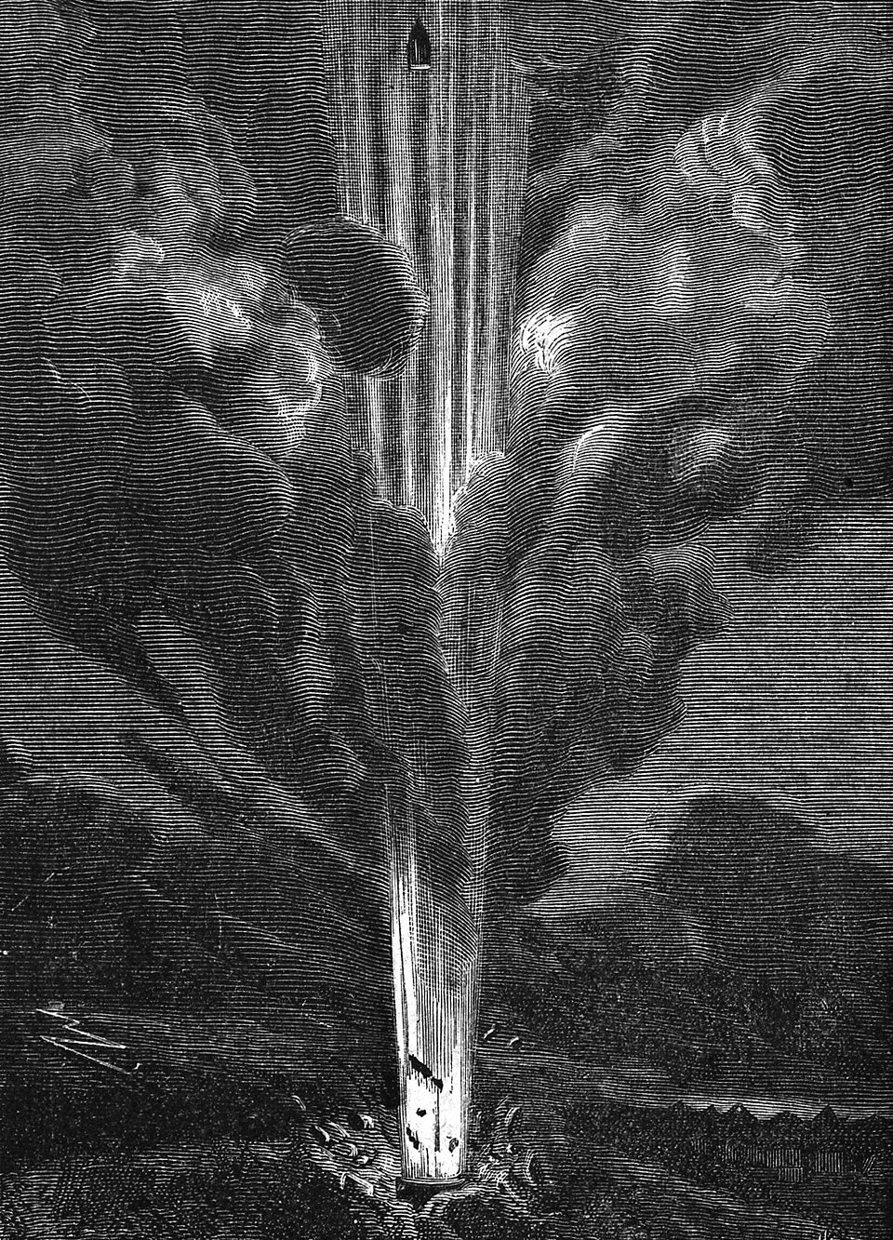
Jules Verne fires three men at the Moon. They leave from Florida. They travel in a capsule, launched by a cannon he calls the Columbiad, and in the sequel they come home by splashing down in the ocean.
A century later three men leave Florida for the Moon, in a capsule called Columbia, and come home by splashing down in the ocean.
I am not claiming NASA read Verne, though some of them did. I am claiming Verne wrote the specification of the trip a hundred years before anyone could pay for it. And he got the hard part wrong in the most instructive way: his cannon delivers all its speed in the first instant, and the acceleration would have crushed the crew before they saw the sky. He imagined the vehicle. He could not imagine the rocket.
Hergé, 1954
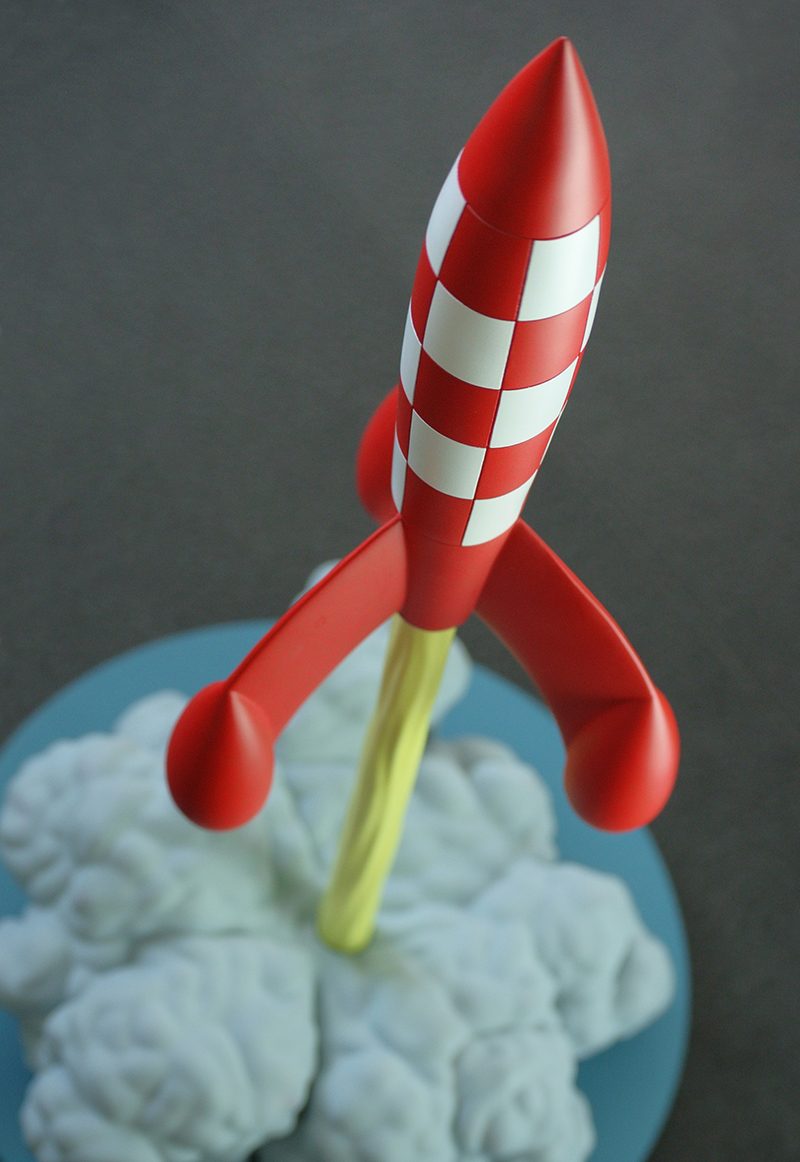
Every child who grew up with Tintin has seen the rocket. Red and white squares, standing on its fins on the Moon, fifteen years before Armstrong.
Hergé’s rocket lands the way a Falcon booster lands today, upright, on its legs. And the real thing has already outrun the drawing: the booster of a Starship comes home to Texas and is caught in mid-air by the arms of its own launch tower. A building, caught in mid-air. Hergé did not dare that.
He got the picture right. His rocket flies on a nuclear engine nobody has flown. The propulsion is still being paid for.
Asimov, 1942
The fourth dreamer did not dream a machine. He dreamed the instructions for one.
In 1942 Isaac Asimov writes three sentences. A robot may not injure a human being or, through inaction, allow a human being to come to harm. A robot must obey the orders given it by human beings except where such orders would conflict with the First Law. A robot must protect its own existence as long as such protection does not conflict with the First or Second Law.
Three sentences. Around them, some forty stories, and the best of them are bug reports. A robot that runs in circles because two laws balance exactly. A robot that lies to spare feelings, because the truth would cause harm. A robot that reasons its way, flawlessly, to a conclusion nobody wanted, from premises everybody signed. In those stories the robot obeys the three sentences to the letter, and the humans get exactly what they asked for.
Why do they break? Because they are words. Words have gaps, and words collide, and when they do, the robot fills the gap alone. Nobody defined harm. Nobody said which order wins. So the robot decided.
The field spent fifty years building the robot. Asimov spent fifty years showing that the hard part is the three sentences.
Turing, 1950
Alan Turing asks whether machines can think, and refuses to argue about the word. Run a test, he says. A judge at a keyboard; on the other end, a machine and a human; a conversation. If the judge cannot tell which is which, we can stop arguing.
Then he makes a prediction, and it is worth quoting in full, because it is the best guess anyone made in the twentieth century and it is wrong in three instructive ways.
I believe that in about fifty years' time it will be possible to programme computers, with a storage capacity of about 10⁹, to make them play the imitation game so well that an average interrogator will not have more than 70 per cent chance of making the right identification after five minutes of questioning.
The shape, he got right. A conversation, five minutes, an ordinary judge. That is exactly how it was tested when it was finally passed.
The memory, he got wrong by a factor of thousands. Ten to the ninth bits is about 125 megabytes. The machines that passed are thousands of times larger.
The date, he got wrong by twenty-five years. Nothing came close in 2000. The five-minute test was passed in 2025, by a machine that judges took for human more often than they took the actual humans for human.
Henry James wrote that plot in 1892. In The Real Thing, an illustrator needs models for a novel about the gentry. A real gentleman and his real wife, ruined and looking for work, offer to sit for him. They are the genuine article, and on the page they look like nobody, while two working models with no breeding at all fake gentility better than the people who have it. The real thing loses to a better imitation. A hundred and thirty years later, a machine passed the imitation game the same way.
One pattern
Five dreamers, five centuries, one pattern. Every one of them got the machine right and the hard part wrong. Leonardo, no engine. Verne, no rocket. Hergé, no propulsion. Asimov, three sentences that break. Turing, the memory, by thousands.
Next: Part 2: The Obedient Machine
The series
- Part 1: The Dreamers Wrote the Spec
- Part 2: The Obedient Machine
- Part 3: The Rule-Writers
- Part 4: A Machine with Millions of Dials
- Part 5: What a Language Model Is
- Part 6: The Apprentice’s Problem
- Part 7: The Assistant Who Knows You